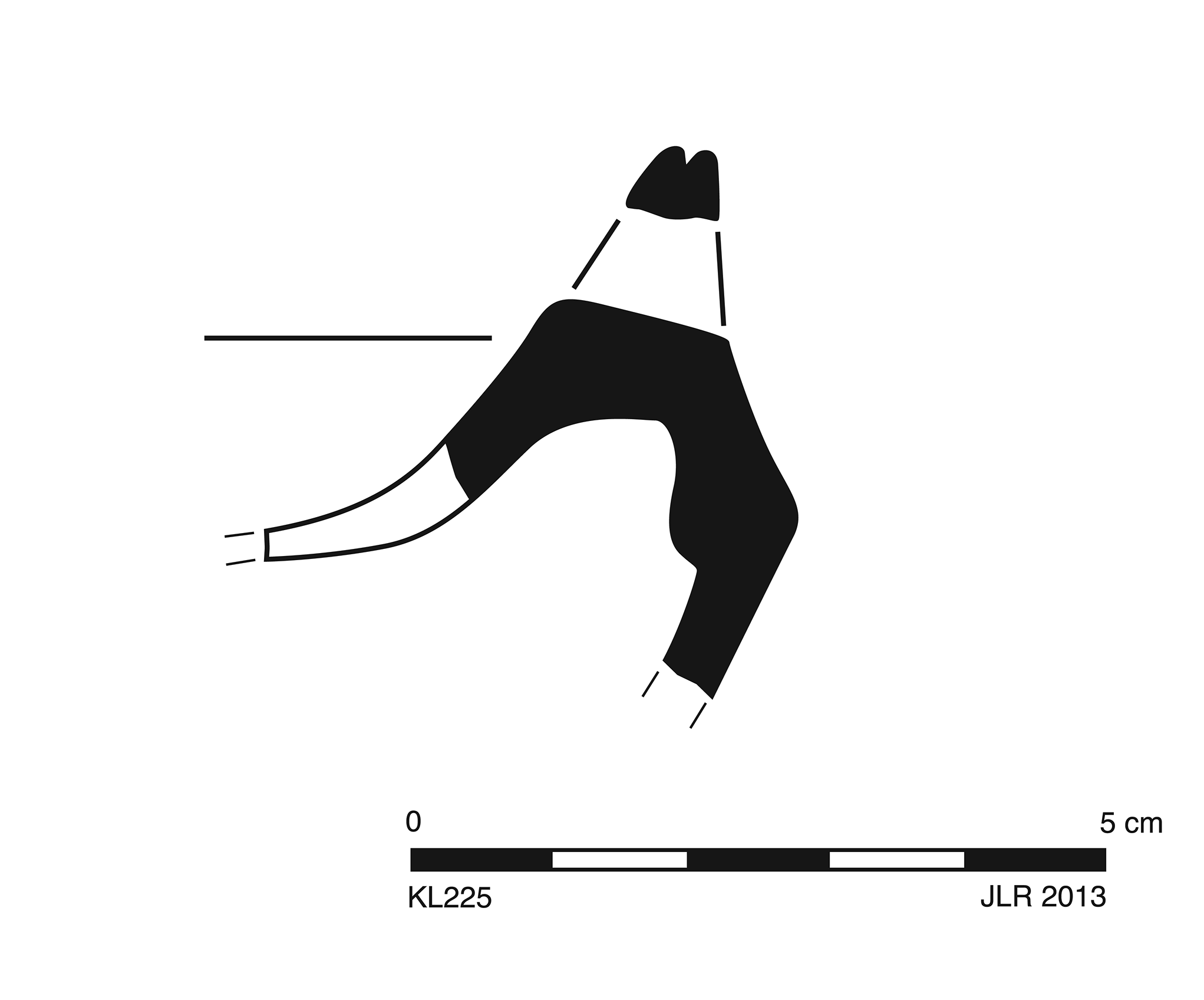
Features typical of late bird’s-head lamps (“Vogelkopflampen”): e.g., Brants1913, p. 13, no. 144, pl. I (Rijksmuseum, Leiden; from Beja, Tunisia); BMLIII, pp. 179, 185, no. Q 1676, fig. 127, pl. 12 (D. M. Bailey; from Tunisia, ca. 120–180 CE); Pavolini1980, pp. 64, 91-94, 115-121, table 2, pl. XVI.2 (tipo V, 4o gruppo).
cf. BMLIII, pp. 203 (signed CCORVRS), 205 (signed ΚΕΛϹΕΙ), nos. Q 1851, Q 1852, figs. 126, 132, pl. 28 (D. M. Bailey; identified as Tripolitanian; ca. 130-200 CE)
Comparanda
cf. Heres1972, p. 62, no. 338, pl. 38 (signed ΚΕΛϹΕΙ), p. 76, no. 478, pl. 51 (signed CCORVRS; Antikensammlung, Berlin)
Comparanda
cf. Pavolini1977, p. 34, pl. XX:4 (signed ΚΕΛϹΕΙ; Museo Nazionale di Napoli)
Description
Circular, concave discus encircled by two grooves that terminate near handle in two circles. Shoulder is broad and somewhat flat. Transverse handle, pierced for suspension; single groove running over top ends at base of handle in three-pronged design with circles at ends. Campanian or Tripolitanian product.
Fabric, firing, surface
7.5YR 7/4, pink. Hard, dense, medium fine fabric; granular to slight hackly(?) break with slightly rough surface texture; rare, small, subangular to angular, black inclusions; very rare, small, tabular, lime bits.
Preservation description
One large fragment preserves entire handle, upper shoulder, and small part of discus. Slight, extensive abrasion with pitting; worn breaks; thin, faint film of encrustation.