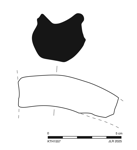
- Bassit Amphora [permalink]
- Type
- Typology Item
- Not after (date)
- 425
- Not before (date)
- 50
- Broader
- Amphora
- Bibliography
- MillsReynolds2014
- Description
- Series of amphoras with a chiefly Levantine distribution and manufacture that peaked during the Early to Middle Roman centuries (2nd-3rd century) but continued through the late 4th century. Named after the cape and town Ra’s al-Bassit (anc. Posidion), production centered on the north Syrian coast and Jabal an-Nusayriah. All forms have a rounded body with a cylindrical neck and outwardly projecting (or folded) lip and vertical loop handles, but the earlier forms (1/2) are more squat than the later ones (3-5), which show a sharply grooved handle. Hard, reddish fabric with sandy texture, variously containing black sand, pale quartz, red rocky, lime, and basalt inclusions; cf. mortaria.
- Has geographic origin
- Syria
- Belongs to Historical Period
- Early Roman (Historical Period)
- Belongs to Historical Period
- Late Roman (Historical Period)
- Belongs to Historical Period
- Middle Roman (Historical Period)