- Rhodian Amphora [permalink]
- Type
- Typology Item
- See also
- https://archaeologydataservice.ac.uk/archives/view/amphora_ahrb_2005/details.cfm?id=74
- Broader
- Amphora
- Typological identification comment
- Roman form also classified as Augst 6, Callender 7, Camulodunum 184, Ostia 65, and Peacock & Williams Class 9.
- Bibliography
- EmpereurHesnard1987, pp. 18-20
- Bibliography
- EphesosXV.1, pp. 35-50 (Type 1; T. Bezeczky)
- Description
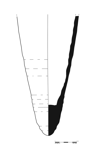
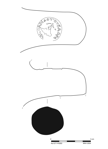
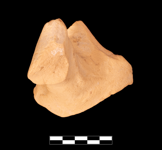
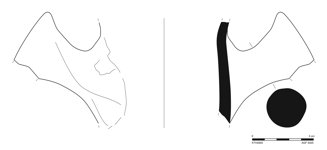
- Popular wine containers of the Hellenistic to Early Roman eras in the Aegean basin and beyond into Africa and Europe. Large production on Rhodes and especially the Rhodian Peraea (Caria). During all periods the characteristic shape is an ovoid body with a solid spike, a tall cylindrical neck with a beaded rim, and tall rod handles that peak at a sharp curve. Hellenistic forms (late 4th-early 1st century BCE) typically have a relatively wider, slightly more conical body and a more rounded peak on the handles, which display on their upper face a manufacturing stamp naming the eponymous magistrate and fabricant. Roman forms (mid-/late 1st century BCE-early 2nd century CE) have a narrower body, and the peaked handles often have a triangular projection that gives a horned or “bat-wing” appearance. Multiple fabrics have been observed, but the commonest are hard, fine, pink to light red with small brown to gray particles and sizable limestone bits, often showing a thin pale slip.
- Has geographic origin
- Asia Minor
- Has geographic origin
- Rhodes
- Belongs to Historical Period
- Early Roman (Historical Period)
- Belongs to Historical Period
- Late Hellenistic (Historical Period)
- Belongs to Historical Period
- Middle Hellenistic (Historical Period)