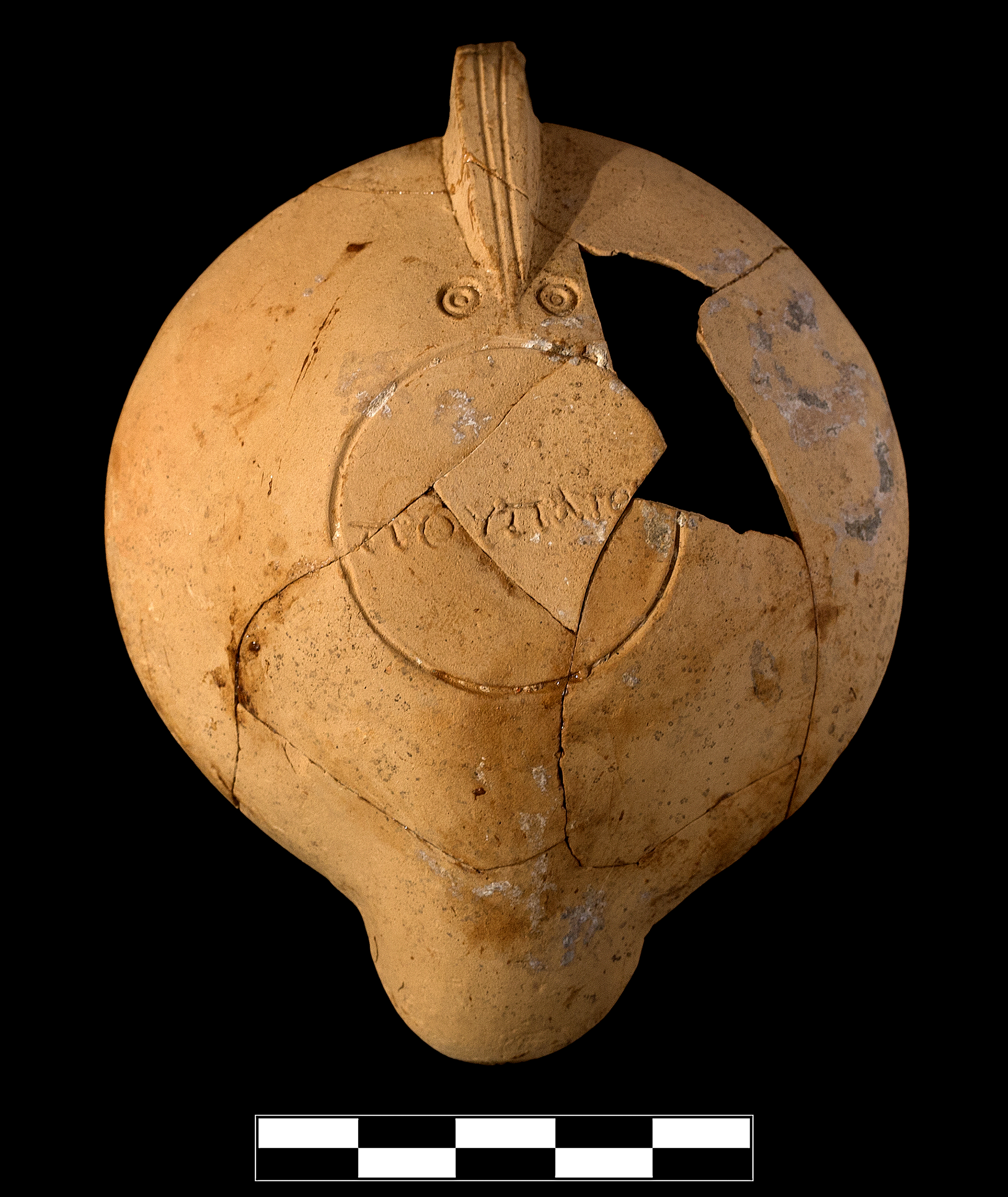
cf. AgoraVII, p. 94, no. 259, pl. 8 (J. Perlzweig; first half 2nd century)
Comparanda
cf. CorinthIV.2, p. 188, no. 556, pl. XI (signed ΕΥΠΛΟΥΔ[ΟΥ?])
Comparanda
cf. FDelphesV.1, p. 188, no. 513, fig. 809=Bruneau1971, pp. 468–469, no. 26, fig. 26=Petridis2011, pp. 326–327, no. 6, fig. 7 (signed ΤΕΡ◎ΤΙΟΥ; tomb near Musée de Delphes)
Comparanda
cf. FDelphesV.1, pp. 188, 190–191, no. 542, fig. 831 (signed ΠΟΥΠΛΙΟΥ; tomb at Pylaia near Delphi, 2nd century)
Comparanda
cf. Konstantinou1965, p. 305, no. 12, pl. 359:γ=Bruneau1977, p. 276, no. 66=Petridis2011, pp. 324–325, no. 3, fig. 4 (signed ΚΑ[Ρ]ΠΟΦΟΡΟ|Υ; tomb near Musée de Delphes)
Comparanda
cf. Pliakou2007, vol. 1, p. 547, vol. 2, pp. 380–381, nos. 51 (signed ΚΟΙΝΤΟΥ; Nikopolis, probably first quarter 2nd century), 60 (central circle on base; Nikopolis, first quarter 2nd century)
Comparanda
sim. Ke 203-L 52 (north mole, first half 2nd century)
Description
Circular, concave discus has central filling hole with broad rim and ring, rays, small airhole at bottom, and prominent framing ring. Broad, flat shoulder has large ovules (11 per side) with double circles flanking nozzle. Long kite-shaped nozzle has rounded underside; traces of burning. Ring handle has two grooves. Upper handle slightly overlaps ovules and framing ring; lower handle is flanked by double circles and does not reach base. Body below suture slopes steeply down to base. Flat base has single circular groove around incuse signature: ΠΟΥΠΛΙΟΥ̣.
Fabric, firing, surface
7.5YR 7/6, reddish yellow. Material typical for ware: pale; hard and fine.
Preservation description
Seven large joining fragments preserve complete lamp except small part of lower wall. Slight, sparse abrasion and rare flaking; mostly clean breaks and surface.