cf. Boardman1989, p. 131, no. F65, pl. 63 (Emporio, Chios, early 7th century)
Comparanda
cf. CorinthXII, p. 176, no. 1243, pl. 78 (G. D. Weinberg)
Comparanda
cf. Hjohlman2005, pp. 186, 196, no. 151, fig. 53 (“weighing hook”; Pyrgouthi, Early Byzantine)
Comparanda
cf. IsthmiaVII, pp. 112, 117, no. 419, pl. 65 (I. K. Raubitschek; Temenos)
Comparanda
cf. OlForschXXXII, pp. 53, 56, nos. 161, 162, pl. 15 (H. Baitinger and T. Völling)
Comparanda
cf. OlynthusX, pp. 363–364, nos. 1755–1762, pl. CXV (D. M. Robinson; Classical)
Comparanda
cf. SamothraceXI, p. 1043, no. S207-4 (E. Dusinbery; first quarter 1st century CE)
Description
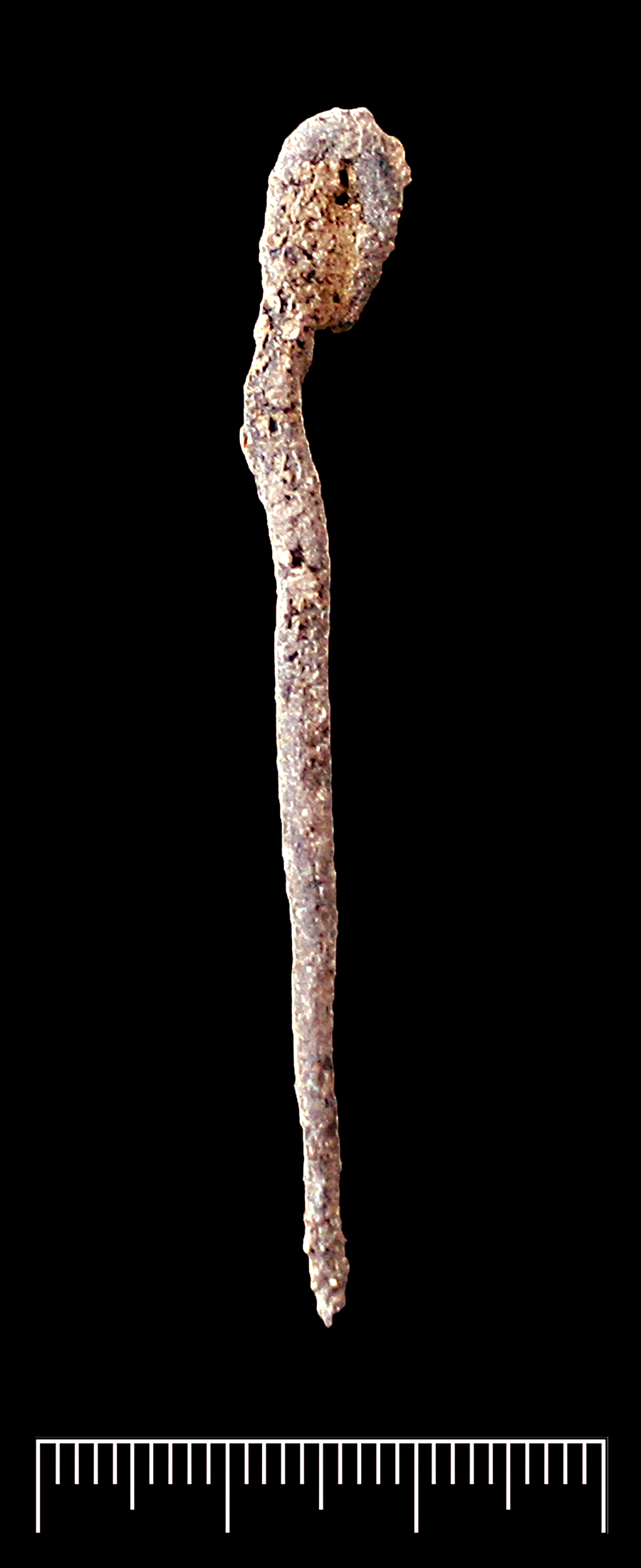
Bronze needle. Somewhat thin wire shaft with circular section that curves over at the top to create a tight eye. The size of this piece suggests that it was used for sewing heavy material and not common woven fabric.
Preservation description
Intact top and middle but missing lower shaft. Moderate bronze disease; slight encrustation.
Published as
Panelas2022, pp. 1068-1069, 1093, no. 715, fig. 22.11
Preserved length
0.064
Thickness
0.002
Thickness
0.004
Chronology comment
Context dated late 5th-mid-6th century or later
Explanation of deposition
Late Roman-Early Byzantine activity in building during or after its use.