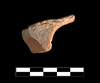
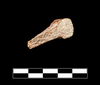
- African Red-Slip Hayes Form 105 [permalink]
- Type
- Typology Item
- Not after (date)
- 675
- Not before (date)
- 580
- Broader
- African Red-Slip Ware (ARS)
- Bibliography
- Bonifay2004, pp. 183-185, fig. 98 (Sigillée type 57)
- Bibliography
- LRP pp. 164, 166-169, figs. 31, 32
- Description
- Large plate. Heavy ring foot tapering to rounded end, sometimes marked outside by groove or offset. Shallow, curving floor to wall; often a raised band on outer floor over foot. Heavy knobbed rim with squared shape, flat on top, convex on outer face, and sharply turned on underside. In general, thin, poor slip on inside and over rim; smoothed floor and rough bottom. Commonest Early Byzantine ARS form. Hayes implied three subtypes in organizing his catalog, which Bonifay formalized into A-C. Type 105A (=LRP nos. 2-7): relatively wide base with high foot often bearing one or two grooves; shorter and straighter walls; quadrangular rim-knob, sometimes tall. Type 105B (=LRP nos. 8-14): relatively narrow base with shorter foot sometimes bearing one groove; thinner, more curved walls; more rounded rim, with upper face aligning with wall and lower face more circular. Type 105C (=LRP nos. 15-17): deeper bowl; taller knob-rim that is oval in section with prominent upper face.
- Chronology comment
- A: end 6th-first half 7th century
- Chronology comment
- B: middle decades 7th century
- Chronology comment
- C: second half 7th century
- Belongs to Historical Period
- Early Byzantine (Historical Period)